The Qur'an marks the times of worship by the Sun's position in the sky — the natural divisions of day and night. These markers are not arbitrary; modern astronomy defines the very same events measurably.
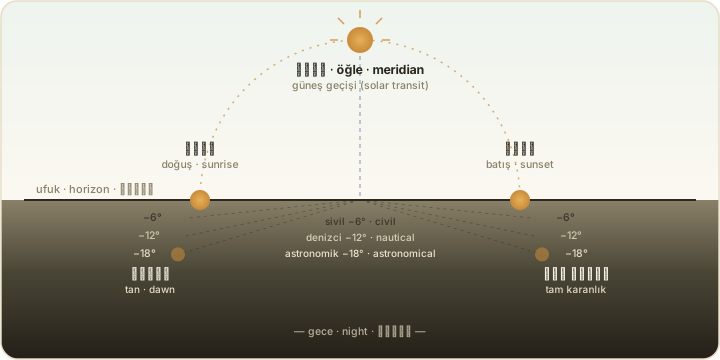
Figure: the Sun's daily arc and its position relative to the horizon — the Qur'anic time-markers (fajr, ṭulūʿ, dulūk, ghurūb, ghasaq) and the astronomical twilight thresholds (−6° civil, −12° nautical, −18° astronomical). USNO definitions.
Qur'anic time-markers → their astronomical counterpart
1) Fajr — the breaking of dawn (17:78 "قُرْآنَ الْفَجْرِ"; 24:58 "صَلَاةِ الْفَجْرِ")
"…and the dawn recitation; indeed the dawn recitation is witnessed." (17:78)
The first light that spreads horizontally along the horizon (true dawn, al-fajr al-ṣādiq); it coincides with the onset of morning twilight. The pale vertical, cone-shaped glow seen earlier is the false dawn = zodiacal light (sunlight scattered by interplanetary dust); it is white and is not the dawn — true dawn lies horizontal and is reddish.
2) Ṭulūʿ al-shams — sunrise (20:130 "قَبْلَ طُلُوعِ الشَّمْسِ") The Sun's upper limb touching the horizon. USNO: it occurs when the Sun's center is 50 arcminutes (50′) below the horizon — 16′ apparent radius + 34′ atmospheric refraction.
3) Dulūk al-shams — the Sun's turn from the zenith = noon (17:78 "لِدُلُوكِ الشَّمْسِ")
"Establish prayer at the decline of the Sun until the darkness of night…" (17:78)
Dulūk is the Sun passing the meridian (the sky's overhead line) and leaning westward. In astronomy this instant is the solar transit = local solar noon: the Sun crosses the observer's north–south meridian.
4) Ghurūb — sunset (20:130 "قَبْلَ غُرُوبِهَا") The Sun's upper limb vanishing at the western horizon — the mirror of sunrise (center again 50′ below).
5) Ghasaq al-layl — the darkness of night (17:78 "إِلَىٰ غَسَقِ اللَّيْلِ") The moment evening twilight fully ends and the sky goes dark. In astronomy this is the end of astronomical twilight: the Sun is 18° below the horizon; beyond it, scattered sunlight falls below starlight (USNO).
6) The ends of the day & the hours near night (11:114 "طَرَفَيِ النَّهَارِ وَزُلَفًا مِّنَ اللَّيْلِ"; 20:130 "أَطْرَافَ النَّهَارِ … آنَاءِ اللَّيْلِ")
"Establish prayer at the two ends of the day and in the [early] hours of the night." (11:114)
The twilight bands that bracket daytime. Astronomy measures them in three stages: civil (Sun −6°), nautical (−12°), and astronomical (−18°) twilight (USNO).
An honest limit
The Qur'an states the Sun's observable positions: rising, setting, turning from the zenith, the fall of darkness, the spreading of dawn — all real, universal, measurable astronomical events. But the Qur'an gives no numeric angle. Tying a time precisely to −18° or −15°/−17° is a modern computational/calendrical convention, and sources differ; it is not a claim of the Qur'an. So science confirms the markers are real and measurable; the exact threshold is a convention.
Scientific sources: U.S. Naval Observatory — Rise, Set, and Twilight Definitions; NOAA Global Monitoring Laboratory — Solar Calculator Glossary. Qur'an cited as Surah:Ayah; meal by M. Okuyan.